An open-source humanoid
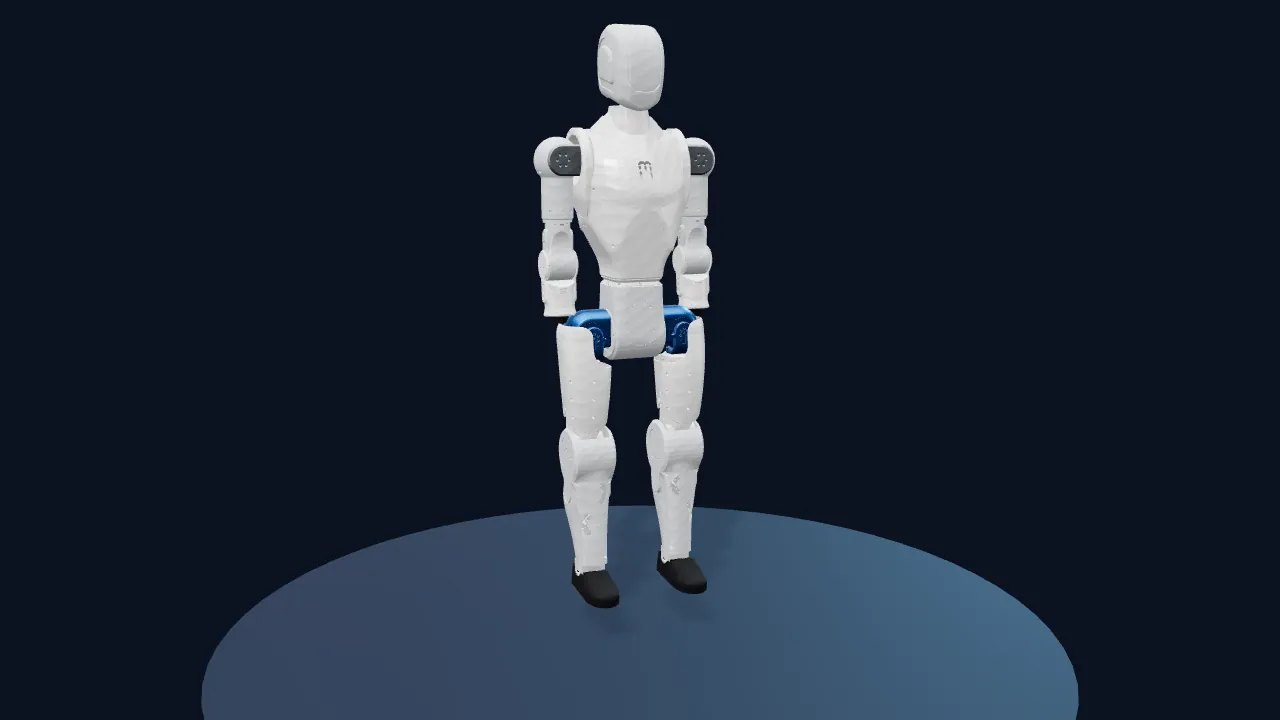
Asimov 1, the open-source humanoid from Menlo Research, as the STEM Engine models it.
Asimov 1 at a glance
Asimov 1 is a full-size humanoid robot designed by Menlo Research and published as open hardware under the CERN-OHL-S-2.0 licence. The CAD, the simulation model (a URDF file), the electronics and the wiring harness are all public, which is why you can study every part of it in this course.
| Height | about 1.25 m |
| Mass | about 32 kg (the sum of the URDF's link masses) |
| Actuated joints | 23 in the URDF, plus 2 neck actuators |
| Actuators | ENCOS, five families, 48 V, CAN at 1 Mbps |
| Battery | 13S4P lithium-ion, 46.8 V nominal, 10.5 Ah |
| Motion computer | Radxa CM5 on the Motion Control Board |
| Head computer | Raspberry Pi 5 |
Menlo Research's published figures are 1.2 m and 35 kg, which you will hear in the videos. This course uses the simulation model's own numbers: its standing height and the sum of its link masses.
How the course works
Each module has short readings, one or two Asimov Labs and a quiz. A lab is a 3D scene with tasks: pose a joint, play a motion, find a part. The lab checks each task from what you actually do in the scene, and the lesson completes itself when every task is ticked.
Module 9 is the practical: you wire the robot's harness by hand in the STEM Engine, and the STEM Engine grades your wires against Menlo Research's published cable list.
What "published" means here
Two things in this course are Cognita's own, and the lessons always say so:
- The neck's range. The URDF fixes the neck. Cognita animates it with assumed limits (yaw ±60°, pitch ±25°) so the head can look around.
- Board positions inside the body. The boards' shapes and connectors come from the published PCB files; where exactly they sit inside the torso and head is approximate.
Robot model, CAD and harness: Asimov 1 by Menlo Research · CERN-OHL-S-2.0. Cognita's lessons and labs are built on the published design.
Sign up free to carry on with the course, with an AI tutor to help you.
Continue the course