Build It,
Then Make It Move
STEM and robotics taught by building. Wire a circuit and write its code, design and machine the frame, assemble a drone and fly it in a physics simulation, then train a humanoid robot to walk. All in 3D, in the browser, with courses that go from a first circuit to reinforcement learning.
The Tools
STEM ENGINE
Wire circuits on a breadboard in 2D or 3D, write the code for the board (including MicroPython on the micro:bit), and run it to see what it does.
ENGINEERING WORKSHOP
Design a frame or part, make it on a CNC router, laser or 3D printer bench with real G-code, then build and test it.
DRONES
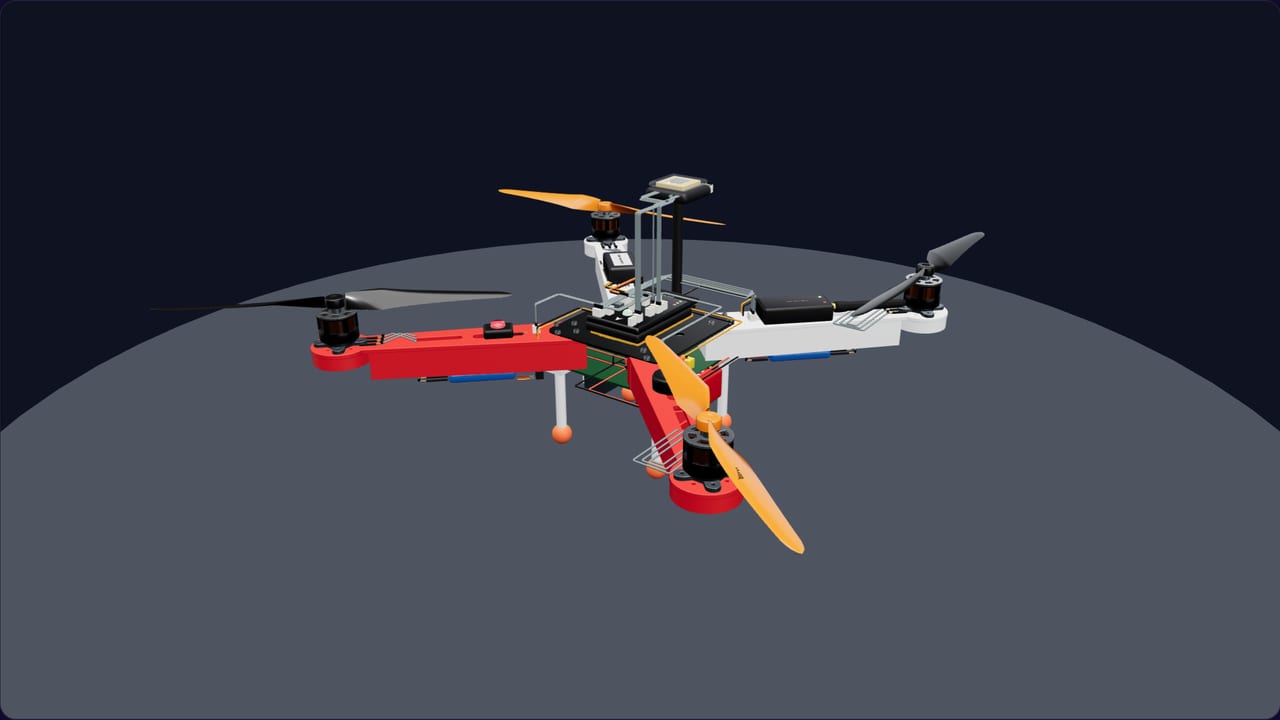
Build quad, hexa, tri and bi-copters with different flight controllers, then fly them in a physics simulation.
HUMANOID ROBOTS
Two open-source humanoids, Asimov 1 and one based on RoboParty's Roboto_origin design: take them apart in Robot Studio, wire their harnesses, and walk them in physics in the browser.
Courses
Start free, then go as deep as you want.
- Engineering Workshop Basics and G-code Basics: short, free beginner courses for ages 13 and up.
- Drone design and assembly, beginner and advanced: build a quadcopter by hand and fly it.
- Asimov 1, introduction and advanced: a full humanoid robot, from fabrication, circuit boards and power to a trained walking policy.
- Open-Source Humanoid: a humanoid built on RoboParty's open Roboto_origin design, wired by hand and walked with its makers' trained policies. Not affiliated with RoboParty.
- The humanoid courses are built on open-source robots, so they are never sold on their own: they come free with Premium.
- Build Together and STEM Challenges: build one device with classmates, and take on STEM challenges that are checked automatically.
Questions
Do learners need a robotics kit?
No. Everything is built and tested in 3D in the browser. Learners who have real parts can follow the same wiring and code on a real board.
What age is it for?
The beginner Workshop and G-code courses are written for ages 13 and up. The drone and humanoid courses go deeper, up to university-level robotics.
Is there coding?
Yes. Learners write the code for the boards they wire in the STEM Engine and the G-code for the machines in the Engineering Workshop, and see the result run.
Can a school use it for a STEM club?
Yes. A teacher can set builds as assignments and follow every learner's progress.